
Ultrasound Tissue Characterisation
A Revolution in Ultrasound
The UTC scanner is a high-resolution ultrasound imaging tool that assesses tendon structure by analyzing fiber alignment and tissue quality. It enables early detection of tendon damage and helps guide targeted treatment and rehabilitation in equines.
How does the UTC scanner work?
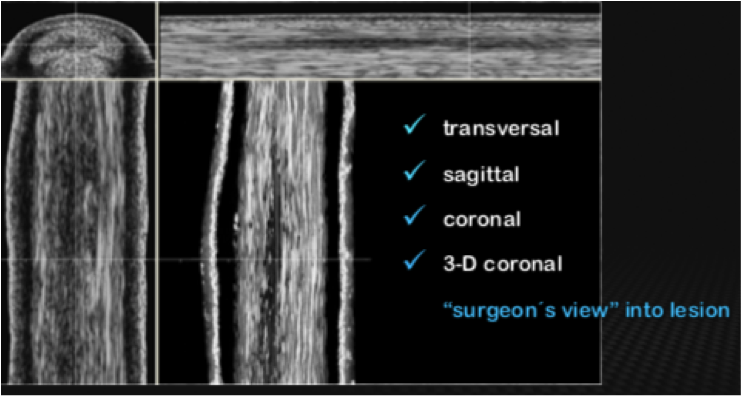
The system consists of both hardware and software for evaluation of tendon structural integrity. The UTC is driven by a precision instrument that automatically moves a high-frequency ultrasonographic probe along the tendon, collecting 600 transverse images at regular intervals of 0.2 mm.
These images are processed by compounding contiguous transverse images into a 3D ultrasonographic data-block that can be used for:
- Tomographic visualisation of the entire tendon in one view.
- UTC and quantification of the integrity of the tendon or ligament matrix.
- Accurate calculation of lesion size.
The UTC scanner has become world-renowned for its ability to:
- Carry out an assessment of the load effect of training and exercise levels on the tendon leading to early detection of tendon weakening and injury.
- Regular scans will allow monitoring of tendons and will make decisions about the ability to perform possible.
- Assessment and staging of healing of injuries leading to customised and guided rehabilitation for the horse.
Not only does a UTC scan allow us to tailor a rehab programme exactly to your horse’s injury, but it can also determine the effects of exercise levels on fibre structure in the tendon. This allows us to be proactive in managing the tendons before possible tendon strain and rupture.

Designed To Give You All The Information You Need
No other technology can offer this amount of information regarding tendon fibre composition meaning no more guess work.

The scanner will detect and display 4 different fibre types/patterns:
- Green: healthy flexible fibres.
- Blue: less flexible and less organised fibres. These are present during healing, but also excessive in scar tissue.
- Red: fibres that are separated as present in lesions and overstrain.
- Black: complete lack of fibre structure/fluid.
It is the percentages of these different fibres types in areas in the tendon that allows accurate assessment of the extent of damage, the quality of healing and to establish the optimal exercise the tendon can handle in order to achieve optimal results.
Inside the Tendon: Real UTC Scan Cases
These are real-life examples of equine tendon scans using UTC technology — revealing hidden damage, monitoring recovery, and guiding better treatment decisions.

The above example shows how difficult it is to assess scarred tissue in the tendon using ultrasound only. It is only after using UTC technology that the large scared (type II, Blue fibres) area is clearly visible. This horse was planned to go back into training but the fact that there is already “tearing” at the scar (red fibres dotted around the scar) indicates this horse is clearly not ready for training.

Above is an example of healing patterns as shown by UTC; the top image shows complete rupture with blue and red fibres (check ligament), the middle image is a month later with much more green fibres and the bottom image is after 3 months of combined use of UTC, TendonPro DSS, ArcEquine and shockwave showing complete healing.